AI Journey at Rallyday - UC #1: Thesis Deck Generation
Ongoing series on our data / ai project - this time on how we build thesis decks at Rallyday
Overview & Business Value
Automates the generation of sector thesis and point-of-view (POV) presentation decks. A deal team member provides the sector or angle, any market context they have on hand (including AlphaSense exports or research they pull manually), and the system retrieves institutional knowledge via Glean, then drafts a structured PowerPoint deck. Target: reduce deck creation from days to under an hour of net team time.
Platforms & Integrations
Technical Approach
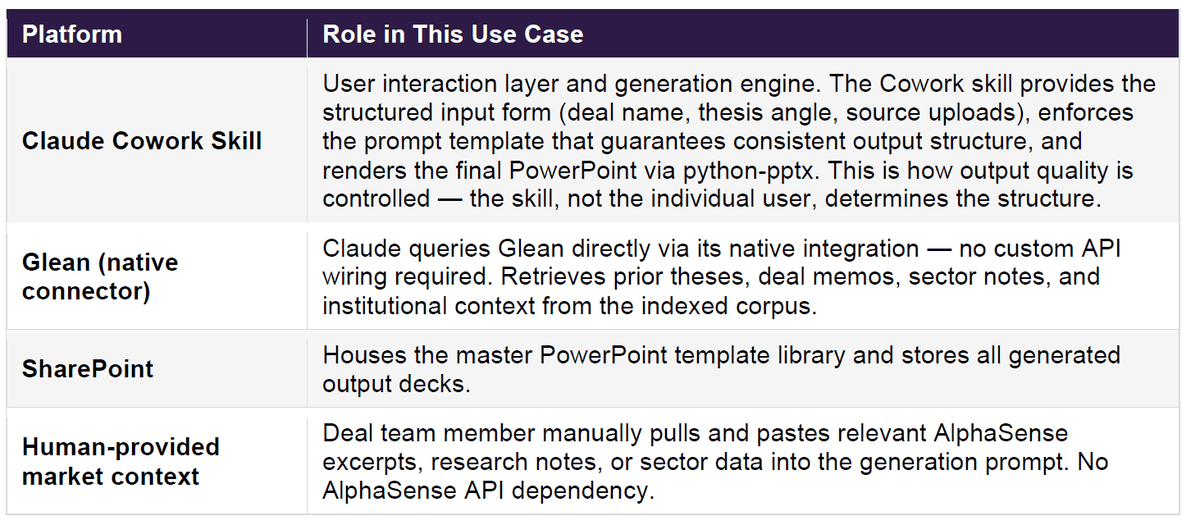
The Glean-Claude native connector means Claude can query Rallyday's full indexed knowledge base (Salesforce, SharePoint, Arvo transcripts) without any custom integration work. A deal team member opens a Cowork session, provides the sector or thesis angle and any market context they have on hand — this could be a pasted AlphaSense summary, a sector note, or simply their own framing — and initiates generation.
Claude queries Glean to retrieve all relevant prior theses, deal memos, and sector notes, assembles a structured context brief, then generates the deck outline following Rallyday's standard thesis structure: market overview, sizing, competitive landscape, thesis statement, target profile, sourcing approach. The outline is surfaced to the user for approval before full generation proceeds.
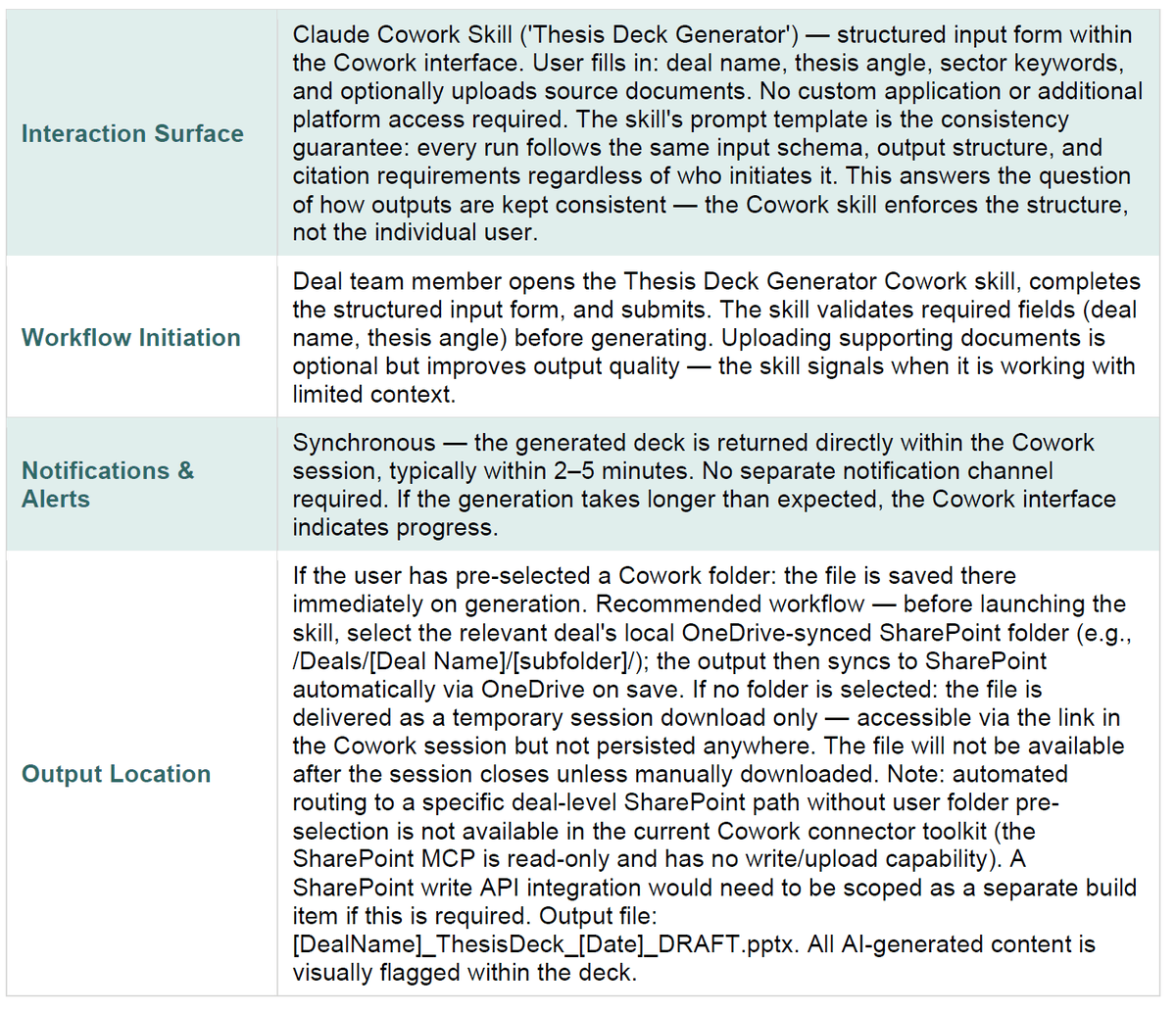
Content generation follows section by section, with each slide citing its source (Glean result, user-provided context, or Claude inference flagged for human review). Output is written into the Rallyday PowerPoint template via python-pptx and saved to SharePoint. The system produces a 70-80% complete draft — the deal team owns the remainder, particularly any proprietary data points and the final sharpening of the thesis narrative.
Delivery & Integration
Agile Breakdown
Epic 1: Template Library & Standards
• Define standard thesis deck structure with deal team (sections, slide count, tone)
• Create master PowerPoint template in Rallyday brand standards, stored in SharePoint
• Build slide variant library (3-5 layouts)
Epic 2: Glean Integration
• Configure Claude-Glean native connector for thesis/sector context retrieval
• Define query patterns for deal team personas (sector search, prior thesis search)
• Build context assembly module: merge Glean results + user-provided context into structured brief
• Implement source citation tracking throughout pipeline
Epic 3: Claude Agent & Generation Chain
• Develop slide-by-slide outline generation with user approval step
• Build section-by-section content generation chain
• Build quality guard: Claude flags unsupported claims for human review
• Implement iterative regeneration: user can re-run individual sections
Epic 4: PowerPoint Output
• Build python-pptx template population engine
• Map Claude output to slide layout positions
• Save output .pptx to SharePoint deal folder with naming convention
Epic 5: Testing & Calibration
• Test against 3 historical sectors with deal team validation
• Calibration sprint: refine prompts based on output quality feedback
• UAT sign-off with deal team
Dependencies & Prerequisites
• Glean deployed and indexed across SharePoint, Salesforce, and Arvo data
• Standard thesis deck structure agreed and documented by deal team before Sprint 1
• Rallyday brand PowerPoint template provided at project kickoff
• Deal team comfortable with providing market context manually (no AlphaSense API dependency)
Definition of Done
• System generates a 70%+ complete thesis deck draft in under 60 minutes from a sector input and any provided context
• Output tested against 3 historical sectors; deal team confirms content is usable without major rewrite
• Source citations present on all claims; unsupported claims flagged for human review
• Output saved automatically to SharePoint deal folder
• Deal team UAT sign-off received
Risks & Assumptions
• Output quality is directly proportional to what the deal team provides as context — if they provide thin inputs, the deck will reflect that; set clear expectations upfront
• Template diversity: scope a single template first, add variants in a follow-on sprint
• Glean index quality depends on prior document organization — if sources are disorganized, retrieval quality suffers