AI Journey at Rallyday - UC #13: Data Room Analysis
We are well on our way in the production phases for our data / ai project. Outline of UC #13 below.
Overview & Business Value
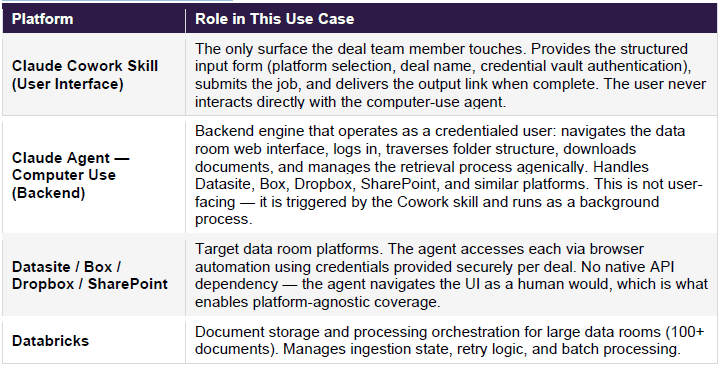
An agentic system that accesses data rooms like a credentialed human user — logging in to Datasite, Box, Dropbox, SharePoint, or any other platform the target provides — downloads and analyzes documents, and produces a structured diligence summary organized by workstream. This is a significantly larger effort than a simple document processing pipeline because it must handle the full diversity of data room platforms, credential management, and the navigation behavior required to access and retrieve documents from secured virtual environments.
Platforms & Integrations
Technical Approach
The fundamental challenge of this use case is data room platform diversity. Unlike a SharePoint-only integration, an agentic system must handle Datasite (the most common PE data room platform), Box, Dropbox, and SharePoint at a minimum — each with different UI structures, navigation patterns, folder hierarchies, and authentication flows. The approach is computer use: Claude acts as a credentialed user, navigating the browser interface of whichever platform the target uses, exactly as a human associate would when assigned to process a data room.
Credential management is its own workstream. The system must accept data room credentials (URL, username, password) securely per deal, use them for the duration of processing, and not persist them beyond that session. A secure credential vault integrated with the agent is required. The agent authenticates, navigates the folder tree, categorizes documents by diligence workstream (Financial, Legal, Operations, Commercial, Management, Technology), downloads each document, and passes it to the analysis pipeline.
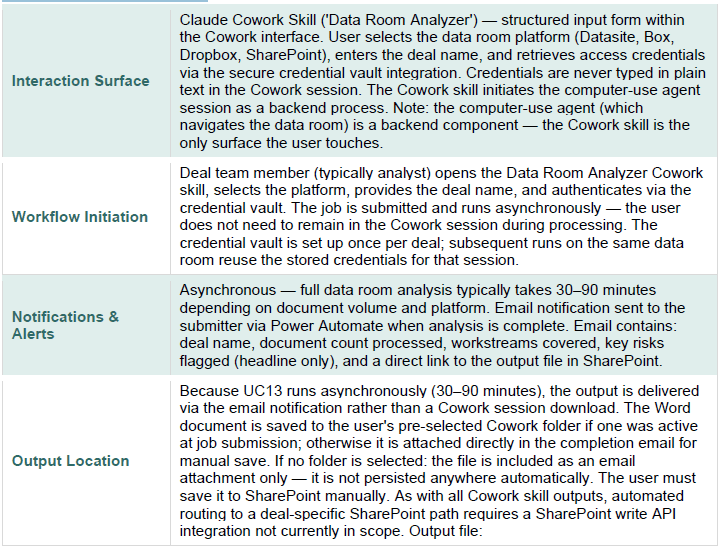
Analysis follows the same structured pattern regardless of platform: workstream-level summaries of 200-300 words, a list of notable findings (positive signals and concerns), and an open questions list per workstream. A cross-workstream synthesis section identifies themes and risks appearing across multiple areas. The output is a Word document structured as a diligence summary memo, designed to feed directly into the IC Memo (UC 6) generation chain — the two are explicitly designed to work in sequence.
Given the complexity of the computer use approach, the build is phased: Sprint 1-2 establish the SharePoint path (simplest, API-accessible), Sprint 3-4 add Datasite (most common in live deals), and Sprint 5-6 extend to Box and Dropbox. Each platform addition is a separate sub-build. The analysis pipeline and document processing chain is built once and shared across all platform paths.
Delivery & Integration
Agile Breakdown
Epic 1: Diligence Framework & Credential Architecture
• Define standard diligence workstream taxonomy with deal team
• Build secure credential vault: per-deal credential storage, session management, no persistence
• Design document-to-workstream classification logic
• Define workstream summary output structure (mapping to UC 6 IC Memo structure)
Epic 2: SharePoint Data Room Path
• Build SharePoint folder traversal and document retrieval (API-based where possible)
• Build document classification and workstream assignment
• Build document download and ingestion pipeline
Epic 3: Analysis Chain
• Build workstream-level summary generation prompt (200-300 words per workstream)
• Build notable findings extraction (positive signals and concerns)
• Build open questions generation per workstream
• Build cross-workstream synthesis section
• Build gap detection: flag workstreams with sparse documentation
• Build Word diligence summary output (mapping to UC 6 structure)
Epic 4: Datasite Computer Use Path
• Build Datasite authentication and session management via browser automation
• Build Datasite folder navigation agent (adapts to platform UI changes)
• Build Datasite document download agent with rate limiting and retry logic
• Test end-to-end Datasite path on a real or simulated data room
Epic 5: Box & Dropbox Paths
• Build Box authentication and document retrieval (API + browser fallback)
• Build Dropbox authentication and document retrieval
• Validate both paths end-to-end with test data
Epic 6: Testing, Iteration & Go-Live
• Test full pipeline (credential vault → platform access → analysis → output) on 3 historical data rooms
• Validate open questions list completeness with deal team
• Build delta report: updated summary when new documents are added
• Security review: credential handling, data retention, access logging
• Deal team UAT sign-off
Dependencies & Prerequisites
• Standard diligence workstream taxonomy agreed before Sprint 1
• Secure credential vault architecture approved by Rallyday security before Sprint 1
• Access to at least 3 historical data rooms (any platform) for testing in Sprint 6
• Databricks environment available for large data room orchestration
• UC 6 IC Memo output structure confirmed to ensure this use case feeds cleanly into it
Definition of Done
• Agent successfully accesses and processes data rooms on all four platform paths: SharePoint, Datasite, Box, Dropbox
• Full data room summary generated within 2 hours for a standard 50-100 document data room (any platform)
• Deal team confirms ≥85% summary accuracy on 3 historical data room tests
• Open questions list validated as comprehensive on all test cases
• Security review of credential handling passed; no credential persistence beyond session confirmed
• Delta report correctly identifies changes when new documents are added
Risks & Assumptions
• Datasite UI changes: Datasite periodically updates its interface, which can break browser automation agents — build resilient navigation logic with explicit failure detection and alerting
• Credential security is non-negotiable: if the vault architecture is not approved by Rallyday's security posture requirements, this use case cannot proceed; security architecture sign-off must come before Sprint 1
• This is the highest-complexity build in the program — 6 sprints assumes no major blockers on any platform path; build a contingency for an additional 1-2 sprints if Datasite navigation proves more complex than anticipated
• Scanned documents in data rooms (common for older financials) require OCR — build explicit OCR pipeline as a document type handler